Skip to main content
Trenchless Technology Then and Now: How OHM Advisors Delivers Smarter, Community-Focused Infrastructure
How OHM Advisors Delivers Smarter, Community-Focused Infrastructure
Six years ago, OHM Advisors began exploring how local and regional decision-makers evaluate trenchless technology as an alternative to traditional dig-and-replace infrastructure projects. At the time, many agencies were still weighing perceived risk against long-term value, often asking whether trenchless methods were truly practical at scale. These insights were explored by Construction Manager Gary Smolinski, who presented them at industry events and in a 2019 blog post about the then-emerging construction approach.
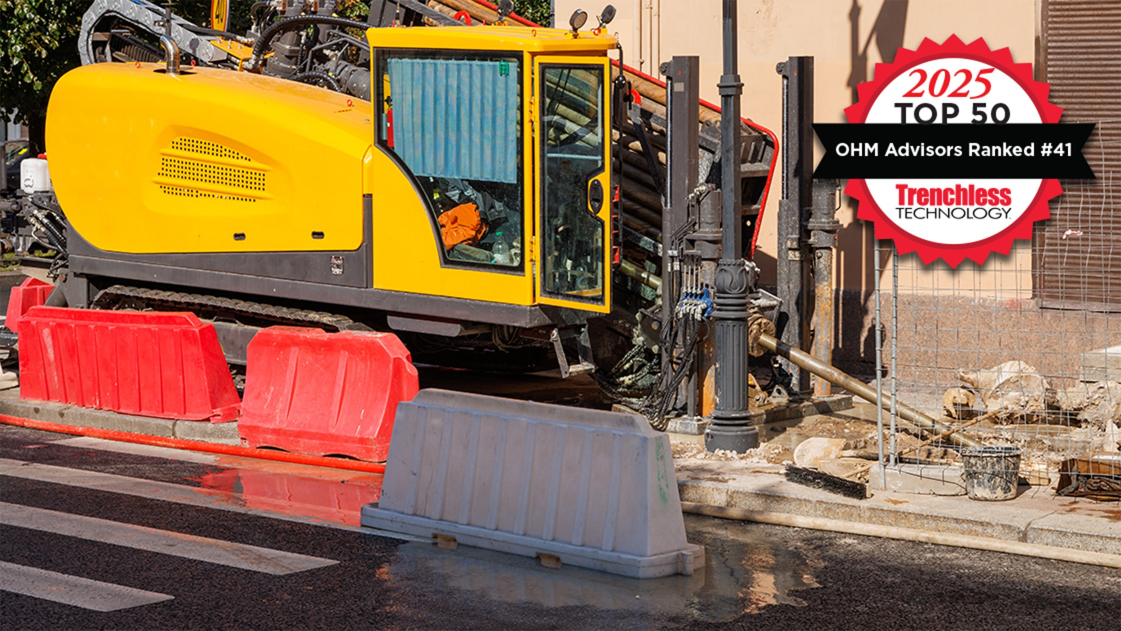
Today, the conversation has shifted. Trenchless technology is no longer viewed as a niche solution. It is a proven, reliable approach that helps communities renew critical infrastructure while minimizing disruption. OHM’s recent recognition as a Top 50 Trenchless Engineering Firm by Trenchless Technology Magazine reflects that evolution and the depth of experience behind it.
From Consideration to Confidence
When trenchless methods first gained traction, adoption often depended on familiarity. Decision-makers needed clear, precise data, trusted partners, and examples of successful delivery. Those factors still matter, but today the industry benefits from decades of proven outcomes, improved inspection tools, and better construction techniques.
Communities now choose trenchless because it delivers tangible benefits:
- Reduced surface disruption and neighborhood impacts
- Shorter construction timelines and fewer traffic closures
- Lower environmental impact and material waste
- Cost-effective rehabilitation of aging systems
Just as important, residents notice the difference. Roads stay open. Access to homes and businesses remains intact. Infrastructure improvements happen with less interruption to daily life.
OHM’s Differentiator: Experience Meets Strategy
OHM’s trenchless work is rooted in a cradle-to-completion philosophy that connects planning, design, and construction oversight. Our teams support clients through every phase of a project, ensuring trenchless solutions are not only technically sound but practical to build and maintain.
Key elements of that approach include:
- Early condition assessment using CCTV inspection and field verification
- Strategic selection of trenchless methods such as Cured-in-Place Pipe (CIPP lining), pipe bursting, Horizontal Directional Drilling (HDD), microtunneling, and pipe jacking
- Close coordination with owners, contractors, and permitting agencies
- Community-focused construction support and communication
As Project Manager Fraser Payne summarized it:
Trenchless isn’t the future of infrastructure—it’s how smart communities get it done today.
Projects That Reflect Real-World Impact
OHM teams are applying trenchless methods to solve complex infrastructure challenges under real constraints.
- Sugarbrook Water Main Rehabilitation, Ypsilanti Township, MI
A multi-year program replacing 12,000 feet of aging cast iron water mains with pipe bursting and HDD. Streets and sidewalks stayed open, public meetings kept residents informed, and phased construction minimized neighborhood disruption.
- LCWA Water Main System Improvements, Divisions A, B, & C, Brighton Township, MI
Completed in 2025, this multi-division project strengthened LCWA’s water system through strategic upgrades and trenchless construction. More than 14,000 feet of new water main and two crossings beneath US 23 delivered critical transmission improvements while minimizing impacts to traffic and the surrounding community.
- Hancock Sanitary Sewer Rehabilitation, City of Hancock, MI
CIPP lining and spot repairs reduced the need for deep excavation, improved system reliability, and controlled costs, all while respecting residents’ daily routines and the broader community flow.
Then vs. Now: How Trenchless Adoption Has Evolved
Many of the principles outlined in Gary’s previous post about trenchless remain relevant today. Local decision-making, risk awareness, and trust in delivery teams continue to shape infrastructure choices. What has changed is the level of confidence. Trenchless technology has moved from an alternative to an expectation for many communities.
Recognition in the Top 50 Trenchless Engineering Firms underscores how far the industry and OHM’s practice have come. More importantly, it reinforces a simple truth. Infrastructure solutions should be effective, efficient, and respectful of the communities they serve.
For additional perspective on how trenchless adoption has evolved, the original 2019 insight remains a valuable reference and is available here.