Skip to main content
Kayla McRobb: Meet Our Experts Series
Diving into water resource conservation
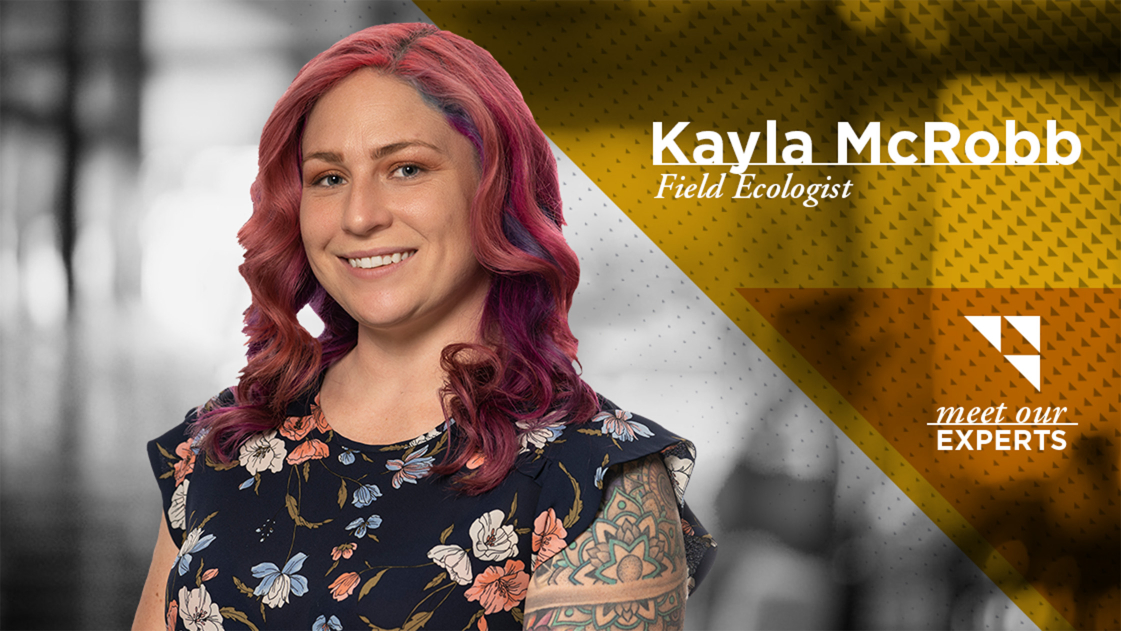
Kayla McRobb is a field ecologist for OHM Advisors’ Environmental and Water Resources Group. We sat down with Kayla to learn more about how her work helps communities improve water quality while protecting natural resources.
Quick Facts:
- Title: Field Ecologist
- Experience: With OHM since 2018; three years prior experience
Advancing mussel conservation with skills and spirit
Kayla brings expertise and enthusiasm to her work at OHM Advisors. She earned her bachelor’s degree in biology and her master’s in ecology, evolution, and organismal biology from Eastern Michigan University, where she focused on lakes and wetlands. Today, she applies that knowledge to a variety of projects, with a focus on conducting underwater mussel surveys. Kayla’s dedication to environmental stewardship extends to her community involvement. She has volunteered with the Huron River Watershed Council’s water quality monitoring program, taught undergraduate courses in biology and technical writing, and is a board member of the Friends of the Detroit River. She also currently co-leads OHM Advisors’ Women in Field Services group, which is dedicated to team members’ connection, support, and professional growth.
What led you to be a field ecologist and specialize in mussel surveys?
I’ve always enjoyed science and being outside. While taking biology classes, I realized I’d rather work with the planet than work with a beaker, and that led me to ecology. After joining OHM Advisors, my team had a “dreamer meeting” that explored the question, “If you could do anything at work, what would you do?” My answer was to scuba dive, because I had just become certified, but I didn’t know how that would work. I later learned about freshwater mussel surveys, which involve diving to identify and relocate mussel populations. In 2020, OHM Advisors conducted a mussel survey in partnership with Renee Mulcrone, who wrote the Field Guide to the Freshwater Mussels of Michigan and is now at OHM Advisors. I dove for the project and fell in love with it. Today, I lead the planning, implementation, and support of OHM’s mussel survey capabilities. We currently have approximately 15 divers on the team.
While taking biology classes, I realized I’d rather work with the planet than work with a beaker, and that led me to ecology.
What else do you enjoy about your work at OHM Advisors?
I appreciate that each day is a little different, giving me the opportunity to learn and grow. I get to work on a range of project types, and the mussel surveys provide a lot of variety because every site is unique. You never know what you’re going to find under water, and it’s fun to solve those on-site challenges in a team atmosphere.
Why might a community need a mussel survey, and, in general, what is involved?
Mussels are a critical touchstone of our ecosystem and food web, acting as filters that improve water quality, among many other benefits. Even though North America has the highest diversity of freshwater mussels in the world, many species’ populations have declined and are protected by state and federal laws. So, any time construction, stabilization, or restoration work is planned over a certain footprint and under the Ordinary High Water Mark—the regulatory boundary of lakes or streams—a mussel survey must be considered. Here in Michigan, surveys take place between June and October, and if we find mussels, we relocate as many of them as possible. Typically, they are moved upstream and away from the construction area in a location approved by the Department of Natural Resources and, depending on the species, the U.S. Fish and Wildlife Service. A variety of approvals and permitting go into the process, and if we relocate more than 300 protected mussels, we go back after a year and check in on them.
Any time construction, stabilization, or restoration work is planned over a certain footprint and under the Ordinary High Water Mark—the regulatory boundary of lakes or streams—a mussel survey must be considered.
What other project types do you work on for the Environmental and Water Resource Group?
While the mussel surveys and the related training and certification are a large part of my work, I also get to use my water quality and environmental science background in a variety of impactful ways. For example, I perform hydrant testing for stormwater and drinking water management plans and capital improvement plans, dry and wet weather sampling for MS4 projects, wetland delineations, or I might even assist our arborists with tree surveys. I also perform water quality monitoring, which I focused on while working at the US Geological Survey.
Tell us about one of your more interesting and complex mussel survey projects.
The City of Sault Ste. Marie engaged OHM Advisors for a repair project for their water intake infrastructure. The intake is in the St. Mary’s River, which borders Michigan’s Upper Peninsula and Canada. Mussels were present in the inspection footage captured by a remotely operated vehicle, which meant we needed to conduct a mussel survey and relocation.
The project was challenging on many levels. The St. Mary’s is a much larger river than our team’s usual work site, and we needed to work at two-to-three times our normal water depth. In addition, timing was critical. Water temperature can be a safety hazard for survey and construction crews, so we couldn’t get into the river until early August, and we needed to have the report and approvals ready by September. River traffic was also a concern—the site is next to a shipping channel, so we had to coordinate with the U.S. Coast Guard and the Army Corps of Engineers, plus make sure hobbyist boaters were aware of our diving activity.
We moved 4,133 mussels, including five of the seven species found in the Upper Peninsula. We got the work done, we stayed under budget, and everyone was safe.
What really made this project challenging and exciting was the number and diversity of mussels we found. For a bridge project, we typically move 50-100 mussels. We moved 4,133 mussels, including five of the seven species found in the Upper Peninsula. We got the work done, we stayed under budget, and everyone was safe. Those are my measures for a successful mussel survey.
What keeps you busy outside of work? Any fun facts?
My go-to fun fact: I once did a guided climb to the top of a redwood tree during a birthday road trip excursion with my husband. I stay busy renovating our 1800s farmhouse and caring for our farm animals.
Click here to contact Kayla for more information about Environmental and Water Resource services at OHM Advisors.